2 March 2026
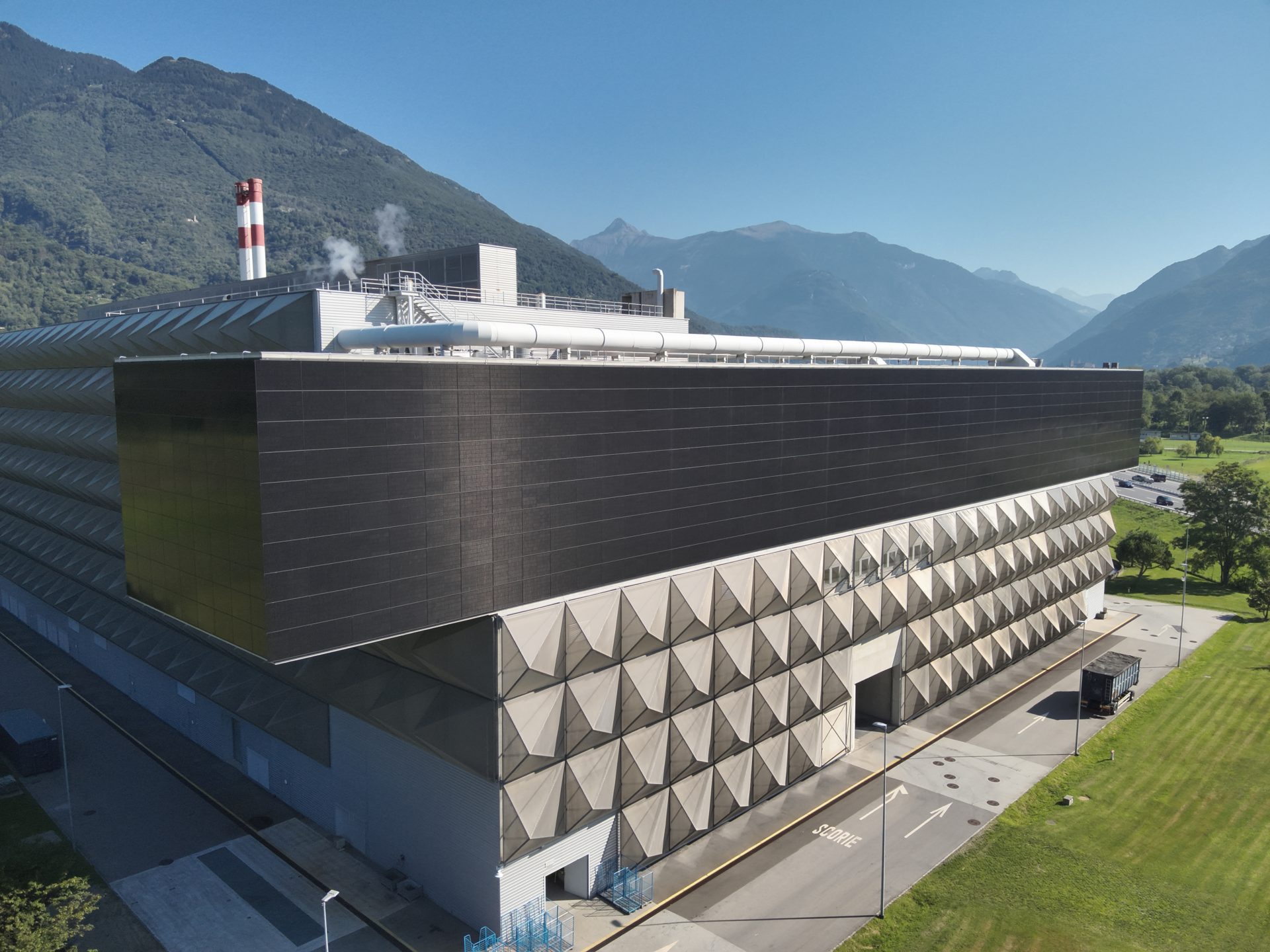
The upper volume of the Giubiasco Waste-to-Energy Centre, suspended above the main structure, is renewed with a photovoltaic envelope that continues Vacchini’s vision, adapting it to contemporary energy challenges.
Credit: Photo © ICTR.
Energy as Architectural Language
Designed by Studio Vacchini architetti following a competition, the Giubiasco waste-to-energy plant is considered one of the most emblematic works of contemporary industrial architecture in Ticino. Its structural clarity, strong volumetric presence, and metal skin defining the envelope give the building a sculptural presence within the canton’s industrial landscape.
In 2023, the decision was taken to expand the existing photovoltaic system (81.4 kW on the flat roof), with the aim of increasing winter production and stabilising the electricity generation profile. In this context, the use of the facades proved to be the most logical solution. The project was developed in agreement with the project’s reference architect, Arch. Eloisa Vacchini, ensuring continuity with the building’s original architectural language.
For compositional reasons, it was decided to completely cover the affected surfaces, extending the intervention to the east and west facades and applying the modules so as to completely cover the elevations. Photovoltaic integration therefore goes beyond a simple technological upgrade; it represents a coherent evolution of the envelope. Energy becomes an expressive element and renews the perception of the building.
Technology and Constraints: A Tailored Solution for the Solar Facade
The new photovoltaic envelope integrates 776 Trina 440 FullBlack modules, for a total installed capacity of 341 kWp and an investment of approximately CHF 450,000 (excluding VAT).
The project had to address strict fire safety and architectural constraints. To comply with current regulations, double-glass (glass/glass) modules were used, together with a dedicated string configuration and the use of power optimisers. These devices enable individual module control and monitoring, improving both safety and performance, even in the presence of partial shading.
This project features the Novotegra mounting system for ventilated facades, consisting of an aluminum structure installed in front of the load-bearing wall. The frame, fixed using spacers, creates an air cavity that ensures rear ventilation of the modules without interfering with the existing building envelope. Electrical connections and fixing elements, completely concealed behind the glass surface, guarantee a uniform and continuous appearance. The choice of black modules with anti-reflective finish further reinforces visual integration with the original architecture.
The building permit application was submitted in 2024; construction took place between October 2024 and March 2025, and the system became operational in April 2025. All the electricity produced is self-consumed on site, given the infrastructure’s high electrical demand. Thanks also to the incentives obtained, the investment is expected to be amortised before the end of the system’s service life.
Module installation was carried out by More Engineering, while electrical connections were completed by Instalux SA.